Honouring our communities: the power of representation
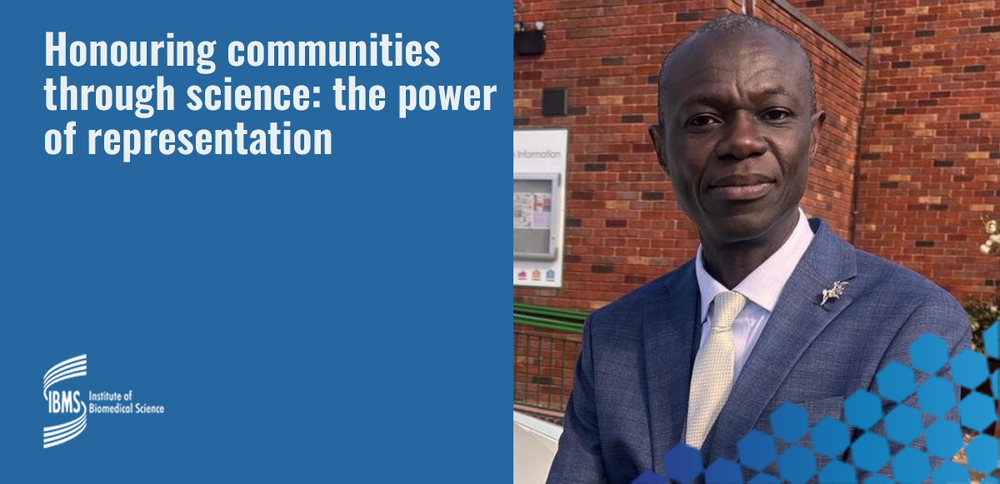
Hammersmith Hospital Site Manager – Blood Sciences, NWLP
I started my biomedical science career in 1990 as a trainee Medical Laboratory Scientific Officer (equivalent to the current BMS) at Hammersmith Hospital. I became State Registered in 1992 after successfully completing the Council for Professions Supplementary to Medicine (CPSM), now HCPC, ‘logbook’ and oral viva exam.
I enrolled onto the Associateship course the following year and later completed the Specialist Fellowship, qualifying as a Fellow in 1995. In 1996, I was successfully appointed as a Senior BMS at the Royal Free Hospital and completed a master’s in biomedical science in 1999.
Two years later, I was appointed as the Chief BMS in the same haematology department where I originally started my career at Hammersmith Hospital. I operated in this role until 2012, when I took on the role of Site Laboratory Manager in Blood Sciences at NWLP.
Since then, I have qualified as a Chartered Scientist and Chartered Manager and continue to practise as a BMS on the bench and teach haematology when able.
The people who helped shape my career
This year’s Black History Month theme, ‘Honouring Our Communities’, means a lot to me both personally and professionally.
Our personal and professional communities, where we come from and those we associate with,, influence and determine our success in many ways – our culture, upbringing, behaviours, outlook and many more aspects. For this reason, it is befitting to honour our communities by acknowledging how we have been shaped and developed.
There have been a number of people who come to mind when I think about my own career. Anne Bradshaw, Marilyn Edwards, Richard Manning and David Roper were among my first Chiefs who inspired me through mentorship and leadership, from being a young trainee and even up until my current role.
Seeing someone who looked like me
I found it so important to see people who looked like me when I was exploring the venture to become a biomedical scientist.
In the very early 90s, as a young Black man at the time, seeing people who looked like me who had achieved success in biomedical science inspired me to progress in my own career, though they were few and far between.
My one and only encounter with Marilyn Edwards, the first Black Blood Transfusion Chief BMS I had met, had a significant impact on me. She actively encouraged me to apply for my first Senior BMS role, which I got at the Royal Free Hospital.
Pulling others along
I attribute my success to the support mechanism I had around me as a young biomedical scientist at the time.
My success in getting appointed as a Senior BMS through the active encouragement I received is a testament to how effective such support is. Similarly, I believe that through my encouragement, the next generation can achieve a lot more success, especially seeing me in such a leadership position.
I have managed to do this on several occasions through direct mentorship, inspiring and coaching at least a dozen Black biomedical scientists to achieve senior or leadership roles. They continue to be exemplars within the biomedical science profession.
Breaking down barriers
The barriers Black biomedical scientists face include the lack of exposure to and direct contact with role models who look like them.
Many may be the first generation of scientists within their local communities, compounded by limited publicity and opportunities to reach out for the necessary encouragement. As these aspects improve, these barriers will fall, making it easier for them to progress successfully.
Each laboratory and its leaders can help break down these barriers by giving opportunities to promote success stories during Black History Month, for example. Actively seeking professional publications from Black leaders would also inspire more Black biomedical scientists to join the profession and follow in their footsteps.
I believe such a strategy would remove existing barriers more rapidly.
My message to the next generation
I would give any young Black person considering biomedical science all the encouragement to consider this rewarding career and aim to progress into leadership.
I would simply narrate my life story, reminding them of their responsibility to pull others along into the field after they have joined successfully, to make it smoother and rewarding for the next generation.