For Hayley Pincott, that journey has taken her from a specialist oral pathology lab to a role in STEM outreach. Through this work, she continues to promote and support the profession in in a different way.
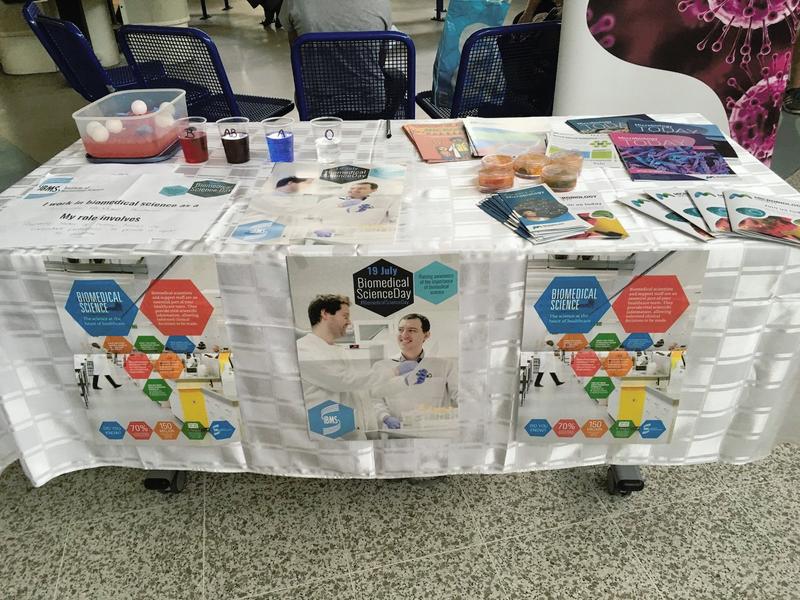
Outreach activity for Biomedical Science Day, 2017
Looking back to 2017, what was your role then, and how has it evolved into the role you hold today?
In 2017, I was an Associate Practitioner in Oral Pathology and Microbiology at the University Dental Hospital in Cardiff. The department moved to the main Cellular Pathology Department at the University Hospital of Wales shortly after I left my post. Due to all the outreach I carried out, I was able to move into a position at See Science, where I'm now the STEM Ambassador Programme Coordinator for the Welsh region. In this role, I'm able to make use of outreach programmes to promote biomedical science.
From your perspective, how has the biomedical science profession changed over the past decade?
Although I'm no longer working in biomedical science, ISO accreditation was a big focus in the lead up to me leaving. I was involved in preparing documents and maintaining records to help make the transition of the dental service into the main Cellular Pathology department as smooth as possible.
With the movement towards patient-led care, I’ve found that many more people are really interested in what a biomedical science service can offer and how it impacts patient care. Public opinion is also moving away from pathology only being about "dead people", which is hugely positive. However, there is still a long way to go, and communication shouldn’t just be with the public—it’s important for other healthcare professionals and local governments to understand the role of biomedical science.
What has been the most significant change in your specific area of practice during that time?
Being an Associate Practitioner in Oral Pathology saw an increase in cases, as I'm very sure every other department can say. Aside from that, I feel quite lucky that being in a smaller team meant many of the lab jobs were still manual. For me personally, although I'm very aware that many labs are becoming more automated, I felt that I was able to maintain some skills that may slowly be lost as tasks become automated. That said, I can really see the benefits of this, with consistency having a huge positive impact on the patient.
In what ways has your work contributed to patient care over the last 10 years?
I feel very lucky to have worked in Oral Pathology, as it was a very unique department because of its size, and it afforded me opportunities that I may not have had in a bigger lab with more staff. I was able to attend a floor of mouth surgery with reconstruction. There was a light-hearted discussion about whether the lab was serious about the amount of formalin needed for the specimen, and it was great to be able to have those discussions. I was then able to attend the MDT where the patient was discussed.
I was amazed at how many different professionals were involved in the care of a patient. Having chances like these to build professional relationships with other healthcare professionals really made the work I carried out, and my role, feel very valued.
What achievement or moment in your career so far are you most proud of, and why?
I can easily say that becoming a registered scientist was a huge achievement for me, especially as I'm not aware of many support staff being professionally registered. I had amazing support from colleagues to complete the IBMS Certificate of Achievement II, which really helped with the application. I feel really passionately about support staff being professionally registered, as quite often over the years support staff have built up a wealth of knowledge and skills, but due to not being qualified, this can sometimes be overlooked. Having recognition for this experience is really important and valuable.
A decade of change and continuing impact
Hayley’s journey shows just how varied a career in biomedical science can be. Her early experience in a highly specialised oral pathology service, supporting the diagnosis and treatment of patients across Wales, has since developed into a role in STEM outreach, showing us the influence biomedical scientists can have beyond the lab.
Her story also points to some of the defining shifts in the profession over the past 10 years, including increasing automation, evolving standards such as ISO accreditation and a stronger focus on patient centred care and public engagement.
As biomedical science continues to develop, voices like Hayley’s help to show not only where the profession has been, but where it’s going, and why its impact continues to matter across healthcare and beyond.
Do you have a story to share for Biomedical Science Day?
We’re always keen to hear from our members. If you’d like to share your story, please get in touch at [email protected]