A full circle moment for Harvey’s Lab Tours
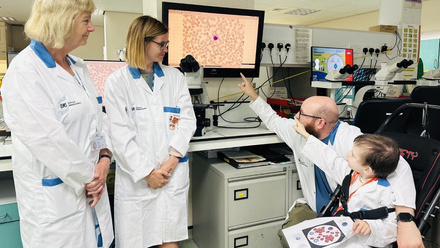
Harvey’s Lab Tours began in 2013, when seven-year-old Harvey Baldwin visited the pathology laboratory at Worthing Hospital while receiving treatment for leukaemia.
Biomedical scientist Malcolm Robinson gave Harvey the chance to follow his own blood sample through the laboratory and meet the scientists behind his results. That first visit went on to inspire laboratory tours for young patients across the UK.
More than a decade later, Harvey’s legacy has created an unexpected connection between his own care and that of another young patient.
When Sarah Schnellmann-Smith heard that one of the young patients in her care was going on a Harvey’s Lab Tour, it brought back memories of Harvey, who she had cared for many years previously.
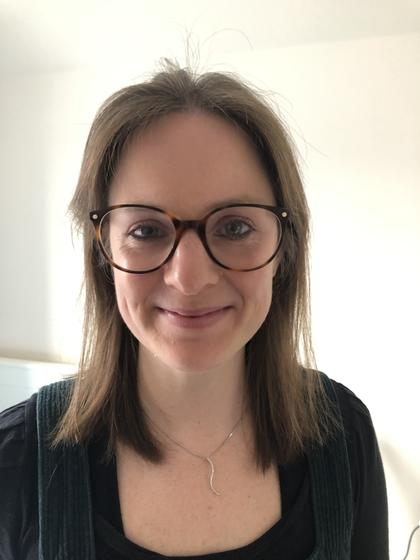
Now an Oncology Clinical Nurse Specialist at University Hospitals Sussex NHS Foundation Trust, Sarah knew Harvey when he was receiving treatment for leukaemia at the Royal Marsden.
I remember him being down in cubicle 10 with Claire, who was there most of the time, but obviously Richard was in and out as well and his brothers.
He was just a really cheerful, cheeky chappy, always up for a bit of a joke with the nurses and playful and having a laugh, even though he obviously felt poorly a lot of the time.
Harvey’s local hospital was Worthing, where a visit to the pathology laboratory gave him the chance to follow his own blood sample and understand what happened to it after it was taken.
Sarah remembers subsequently hearing about ‘Harvey’s Gang’, the programme that grew out of that first visit, but at the time she had no involvement in the lab tours herself.
I knew that Claire and Richard were very determined people, so it had a good foundation, but I didn’t envisage, nearly 10 years on, that it would still be going and growing.
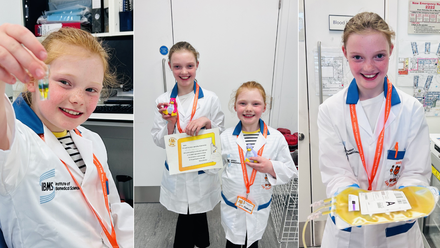
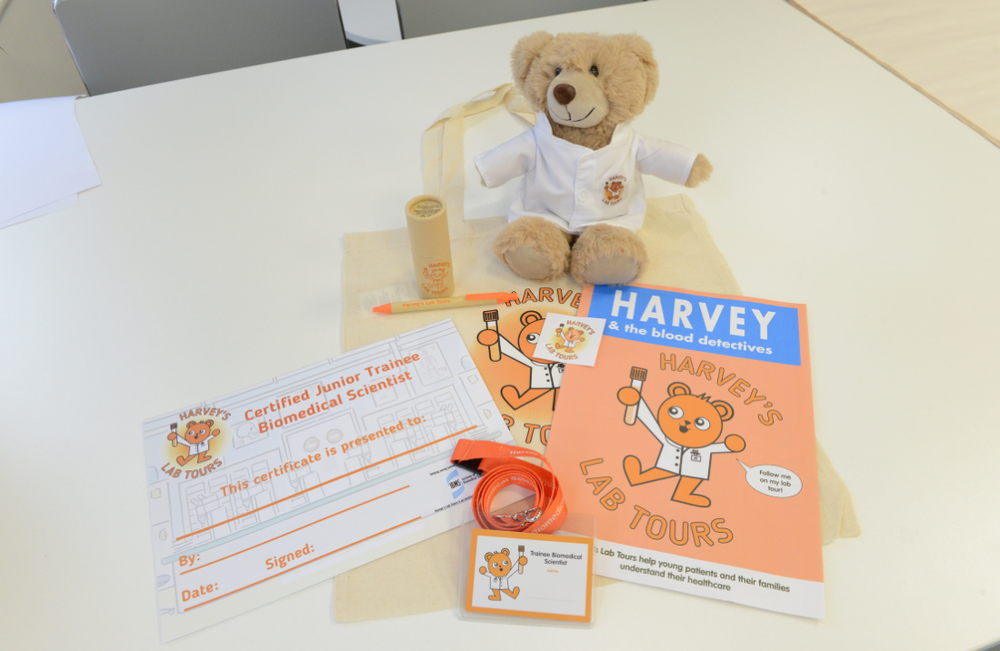
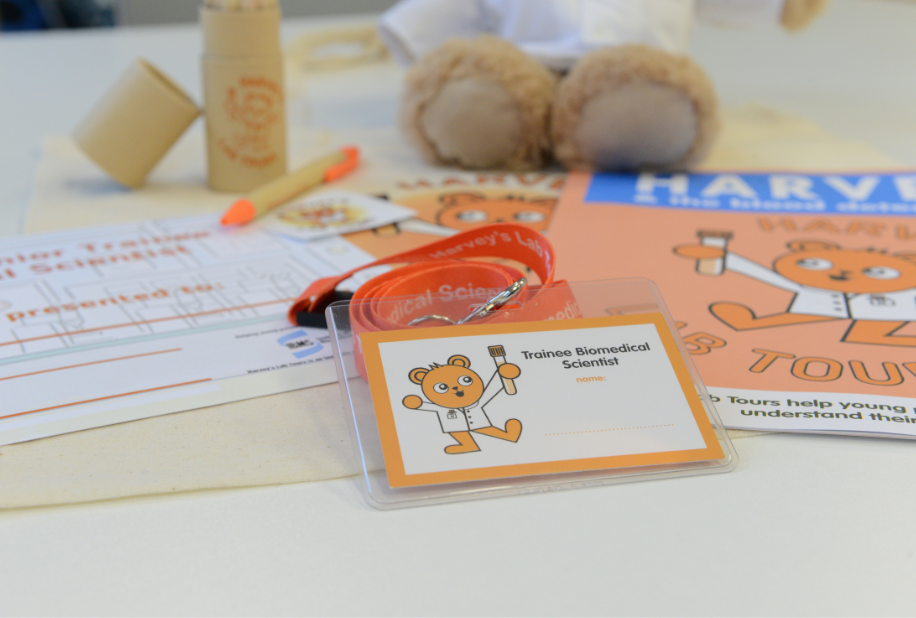
I thought it was something nice that a lab had done and they might carry on doing it for their patients. But the way it's developed with all the extras, like the lab coats and the teddy bears and the booklets. I hadn’t considered it would become such a big thing, but it’s great that it has.
A familiar name returns
Years later, Sarah had moved away from the ward and was working in Brighton when Harvey’s name unexpectedly came back into her professional life.
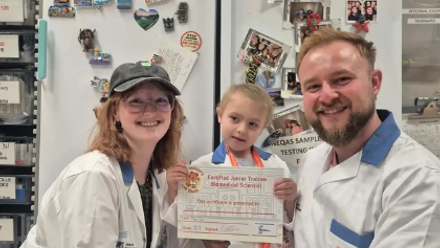
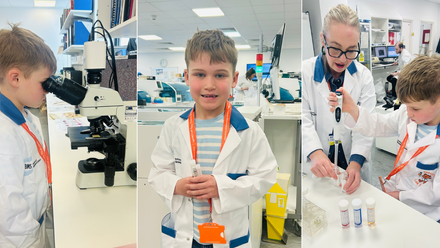
One of her young patients, seven-year-old Teddy, was going to get involved in a Harvey’s Lab Tour after his mum had heard about the programme.
For Sarah, who had known Harvey before the programme even existed, it was a full-circle moment.
It was really special knowing that family at the beginning and that it’s been able to carry on, even with such a huge blip like COVID. There’s a whole team behind it now, which is great.
Now I can be actively involved in supporting Harvey’s legacy by referring more patients to do the tours and spreading the word that way. So I guess making sure that it continues to grow and is sustainable and the legacy carries on, which is really lovely.
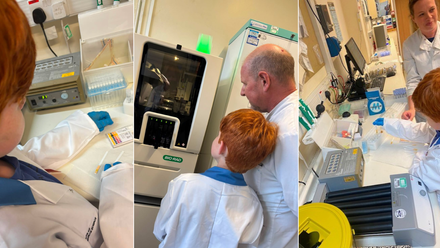
Teddy proved to be a very enthusiastic Junior Scientist. Having received regular blood tests and transfusions throughout his treatment, the processes he encountered in the laboratory were already closely connected to his healthcare.
“He is an extremely intelligent little boy with a lot of questions and really absorbs information,” Sarah said. "When I realised he was doing it, I was like, of all the people on my caseload I could have picked, actually he’s going to be really interested in all of it and it’s really relevant to him."
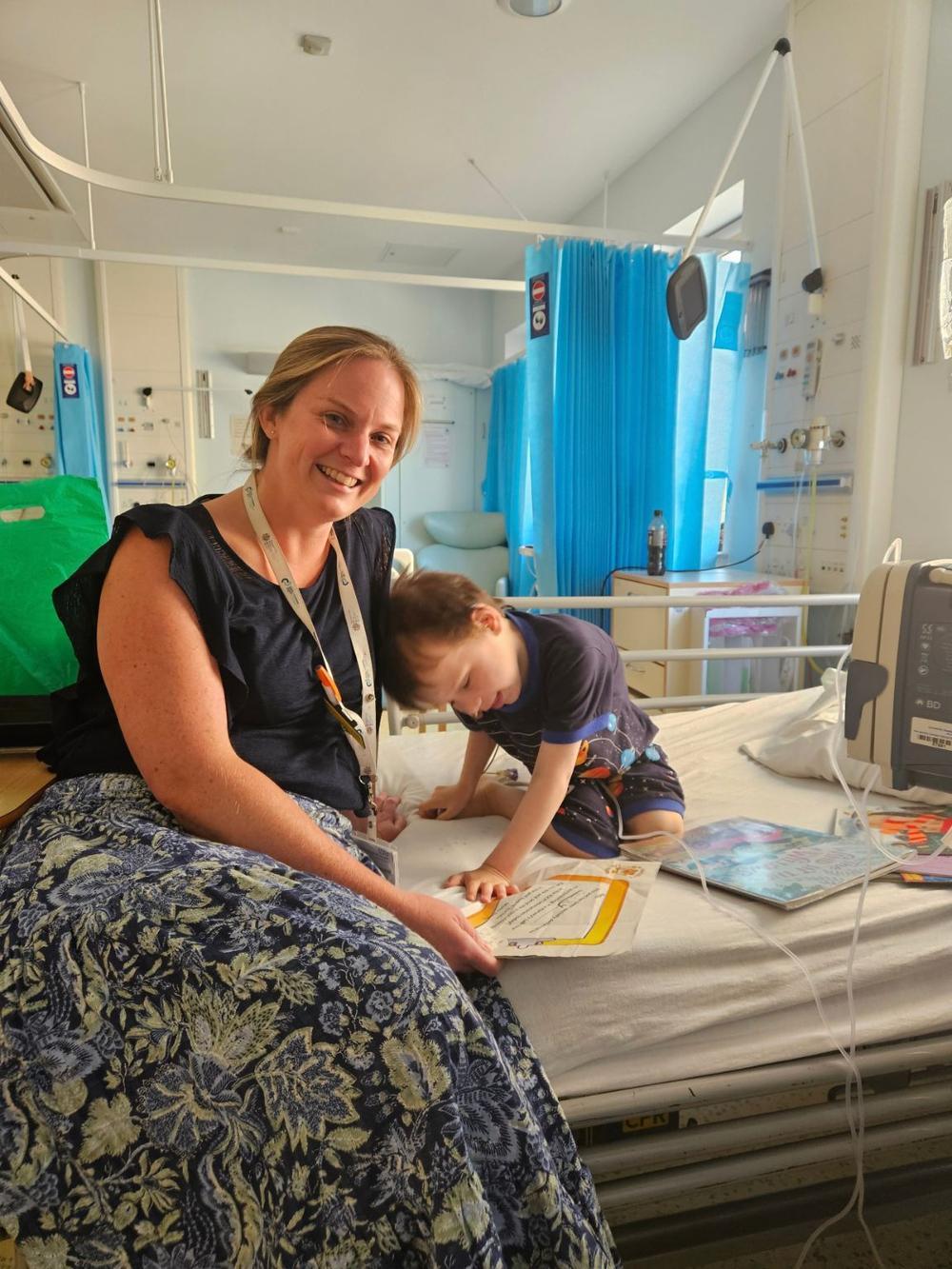
Afterwards, Teddy’s mum told Sarah that he had come home full of stories about his tour.
The day had also offered Teddy and his dad an opportunity to spend time together in the hospital without the usual focus on treatment.
It was a nice bonding experience for them, even though it was in the hospital. It was totally different from their normal experience of hospital.
What happens to the blood?
For Sarah, tours can answer a question that is easily overlooked by healthcare professionals who work with blood results every day: what does a young patient think happens after their sample is taken?
As the treating team, we’re so focused on the numbers. So the blood comes out and then it just disappears for two hours and then someone comes back with a number.
Depending what that number is, you can either go to school or you can’t, or you get a transfusion or you don’t, or you can go home or you can’t.
But what happens in those two hours when the sample disappears? But now they know.
Understanding that process can be particularly important for children and young people receiving long-term treatment.
"So much of it is out of their control,” Sarah explained. “Blood tests are quite invasive, taking bodily fluid out of somebody, so I think it’s important that they feel involved and empowered. It does give them an element of control in the sense that they understand it and they know why we’ve got to do this rather than just being told you have to. There’s a ‘why’ behind it."
More than a laboratory visit
The impact can extend beyond understanding what happens to a sample.
Sarah believes experiences like Teddy’s can complement the relationship healthcare teams build with young patients and their families during long-term treatment.
We know Teddy and the family really well, but it can enhance our relationship with them in terms of holistic care. It’s not just that we need the blood for the result and the treatment, but actually, how can we make this as fun and child-friendly as possible for your child or young person?
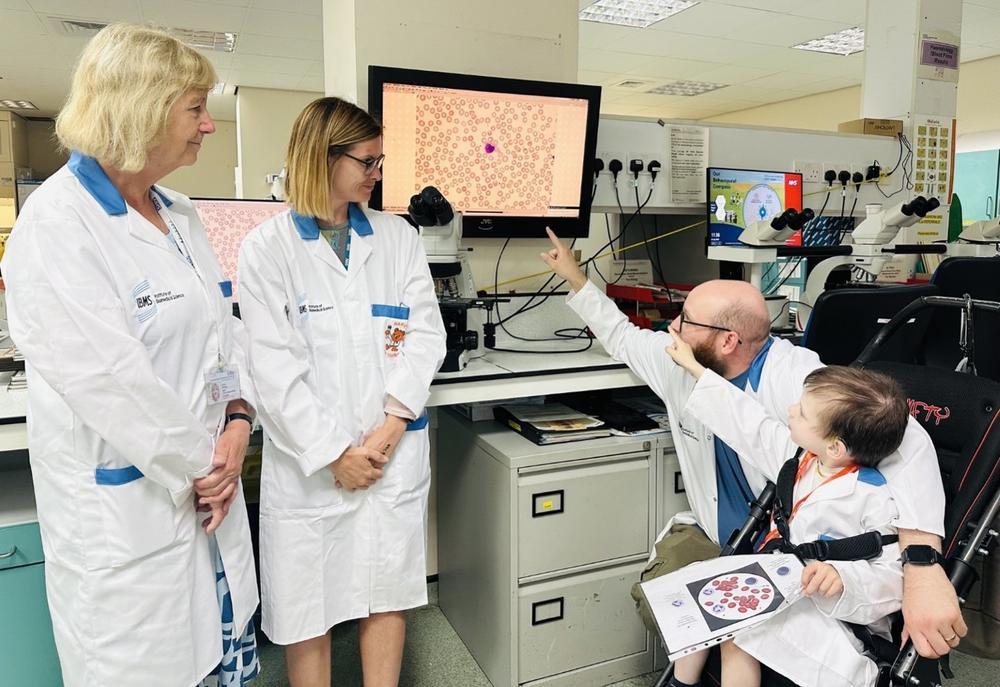
Teddy’s visit also involved coordination between several healthcare professionals. His blood was taken in advance so that he could see his own blood film during the tour, while messages were sent through the pneumatic tube system to his ward and returned with stickers.
For Sarah, seeing colleagues come together to create something special for a patient was another benefit.
Most of the team have said, ‘Well, we want to go on the tour.’ Even for the nursing team and the medics, it’s a fun thing.
In a field where the fun can be lacking, it’s nice to be able to inject some joy.
A tour for every age
Another strength of the programme is the ability to adapt a tour to the individual child.
"The younger ones might find the chute system and looking at the pictures fun, but then we’ve got patients doing their GCSEs who would find it interesting from a science point of view. I think it can be tailored, and that’s what Anne Trezise (Senior Specialist Biomedical Scientist at Brighton & Sussex University Hospitals NHS Trust) is really good at. Giving patients as much or as little information as they want, but just something a bit different."
That flexibility means children and young people can engage with the laboratory in a way that suits their age and interests.
For Sarah, that is an important part of what makes Harvey’s legacy distinctive.
It’s a really fun one and it’s really patient focused and child and young person focused.
It’s actually really tangible that young people are benefiting from this. It’s something that young people can get involved in during their treatment.
It is a way of demystifying it, giving them some control. I think it makes it quite a unique legacy as well.
Continuing Harvey’s legacy
Teddy’s visit has now prompted Sarah to tell the rest of her team about Harvey’s Lab Tours and consider other young patients who might benefit.
Nearly a decade after caring for Harvey, she is now helping the programme he inspired reach another generation of children.
And for laboratories considering taking that first step, Sarah’s message is simple:
I think once you’ve taken that step, you won’t look back. I understand that it’s quite a lot of organisation and risk assessment and everything, but once you’ve done the first one and seen the benefit to the patient, you’ve almost done the hard work and then you’re just reaping the benefit.
It doesn’t just benefit the patient, it benefits the family, it benefits the healthcare professionals as well in terms of team working and just doing something different and fun.
Do you have a story to share from your Harvey’s Lab Tour?
We’re always keen to hear about lab visits and experiences. If you’d like to share your story, please get in touch at [email protected]